Jonas Holthaus and Olga Kessler Thesis Show
February 20, 2011
My dear photographer friends Jonas Holthaus and Olga Kessler will have their thesis show this Friday, Feb 25th 2011 at Zweites Büro, Dortmund. A must see if you are around in West-Germany !
For more Details see this Facebook Event Page.
Highlights 2010, Part I. Depardieu & Giusti
December 26, 2010
Looking through my notes and bookmarks from the last months I decided to blog some of my 2010’s favourites. I’ll start with an amazing magazine cover and surprising editorial photography.
Jonas Unger photographed Gerard Depardieu for ZEIT Magazin. Design Mirko Borsche.


For me, this has been one of the best and funniest editorial shoots and cover of a german magazine in a long long time. Loved it from the beginning. Of course, without Depardieu and his willingness to do some funny, very “open” pictures photography like this wouldn’t have happened. But also a big compliment to Jonas Unger to shoot it like that. For sure, looks easier than it was. See all pages here.
Italian photographer Francesco Giusti did a great series on the members of SAPE, a group of men in Congo / Brazzaville who dress up every weekend like that:


Giusti says about this body of work:
“In Congo-Brazzaville SAPE is an old passion that has never stopped, not even during war years. At the arrival of the French in Congo at the beginning of 9oo, the myth of elegance was born among young people working for the settlers. In 1922, Andre Grenard Matsoua, well-known for his resistance to the settlers, was the first Congolese to come back from Paris well dressed like a true French “Monsieur”, and greatly admired by all his fellow citizens. Today’s members of the SAPE consider themselves as artists and are respected and admired by the whole community. The members of the SAPE take a touch of glamor into their humble environment with their refined style and faultless clothes. Everyone has his own repertory of gestures, marking him from all the others. Elegance is not the only important character. In fact, a true member of the SAPE is a gentleman and a pacifist. Every weekend the members of the SAPE, with their eccentric and amusing nicknames, gather in bars and fashionable dancing halls and parade in the streets among amused children and the applause of passers-by. These extemporized and spontaneous parades are the expression of a urban culture looking for new reference parameters and codes such as non-violence and elegance. They reflect the wish of young people in particular not to be left apart by society”
Beautiful subjects, well photographed. A pleasure to look at all the details.
Some more information here, the blurb book can be ordered for 29,95$ here.
” Adventskalender”
December 5, 2010
Though this blog is a little bit sleepy now (work and diploma consume al my time) I’m still blogging on Bolivia and my thesis project. Until christmas I installed an online advent calender over at danielinbolivia.wordpress.com . Everday a new photograph from my ongoing Bolivia project – check it out!
Diane Arbus video
November 11, 2010
BIG L Edition – more prints produced!
November 11, 2010
During the last weeks, more people decided to support my thesis project and to “order” prints of the BIG L Edition.For 50 Euros (students 25 Euros, S&H incl.), you can still become a donator and get a fine art print of my recent work. Here are some impressions from the studio when I produced and shipped the prints recently.


Review / exhibition design “The city” at C/O Berlin
November 5, 2010
When visiting photo exhibitions I usually try to take some pictures of the exhibition design because there are so many options to hang photographs and art work and deal with different kinds of rooms and locations. I would love to post more exhibition pictures but it takes some time to stitch the photos and prepare the files… Anyways, these pictures are from a show at C/O Berlin, in Summer 2010, called “The City – Becoming and Decaying” with photographs by various “Ostkreuz” photographers. Please click on the images for a lager view.


The following 2 photographers were my favourites:


More impressions from various photographers


Upcoming photo exhibitions in Berlin
November 4, 2010
For the next weeks there are some interesting photo shows in Berlin coming up.
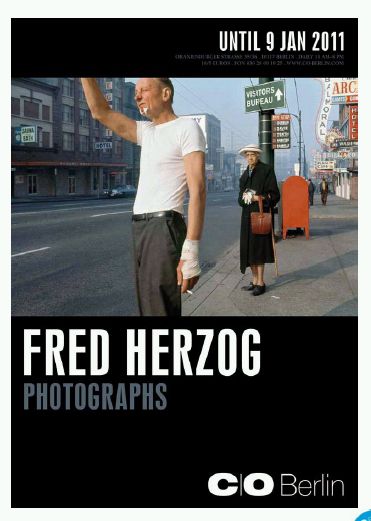
Starting tomorrow 05.1.10 with Fred Herzog at C/O Berlin. Opening reception at 7 pm.
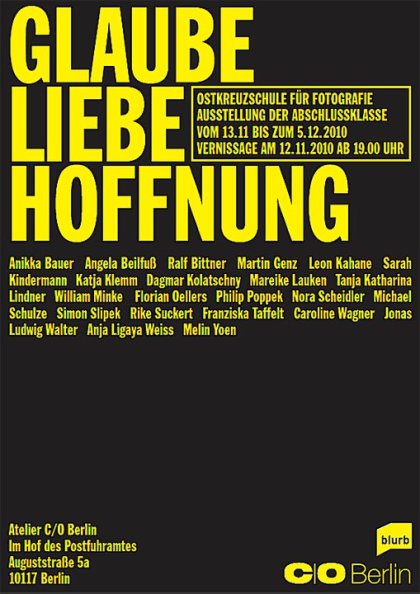
 One week later also at C/O Berlin: Glaube, Liebe Hoffnung, the thesis show by Ostkreuzschule.
And on November 11th, Bruce Wrighton’s photographs have finally arrived in Berlin at Only Photography in Berlin Charlottenburg. Opening reception and book launch from 6-9 pm.

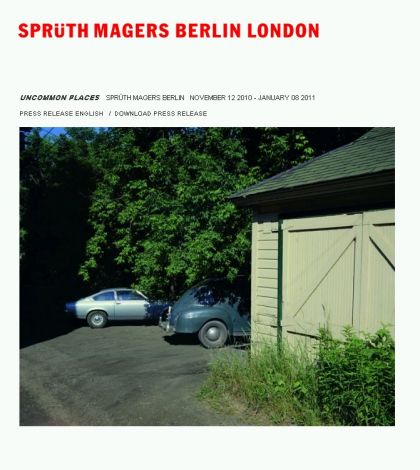
Finally, master photographer Stephen Shore shows it’s all time classic “Uncommon places” at Sprueth Magers. Starting November 12th.
 Hope to see you!
„Fuck the midtones“ – How to make a book with Steidl
November 1, 2010

This Thursday for the first time on tv: the german documentary “How to make a book with Steidl”, Thursday night, 04.10.11 at 3sat.
“How to make a book with Steidl” is a documentary on Gerhard Steidl and his work as a printer and publisher in the art and photography world. The film was awarded the “Golden Dove” and received positive reviews so far, so I’ll definitely see that one!
Watch the trailer on http://www.howtomakeabookwithsteidl.de/file/Trailer.html, buy the dvd here.
Best moment of the trailer: Steidl discussing proofs with a (famous) photographer, who seems to be worried about the midtones of the pictures. Steidl’s reaction: „Fuck the midtones“
Read more here.

Book Case Study with Hester Keijser in Den Haag
October 28, 2010
Hester Keijser ( among many other activities blogger at Mrs. Deane Blog) has announced the “book case study” workshop/weekend in Den Haag, Netherlands, 24.11.10 – 26.11.10 . With guest like Joerg Colberg and the interesting topic of innovative photobooks, this sounds really great!
Dan Winters – Interview and new website
October 3, 2010
Austin (TX) based photographer Dan Winters has a new website with loads of new photographs and drawings I haven´t seen before. Such a pleasure to browse through his website. I think he is genius.
There is also a long interview with him at fstopmag. What I admire most is with how much passion he works on every single detail of a photos shoot (see the interview>Will Ferrel Shoot). Also interesting that he produced short movies with Ferrel for the Ipad version of Wired. Would love to see these.
If you are interested in his work here is an older post when is book came out last year.

UPDATE
There is a good multi media site at Flypmedia about Dan Winters. Here a video with the photographer:
 Daniel on photography